“No Meat” and “Vegan” Don’t Always Mean the Same Thing Here
Here is the first thing worth knowing: when a restaurant says “고기 안 들어가요” (no meat goes in), that usually refers to actual pieces of meat — beef, pork, chicken. It does not automatically include things like anchovy broth, fish sauce, or salted shrimp, because in many Korean kitchens those are not mentally filed under “meat” at all.
This is not a case of Korean restaurants not understanding vegan food. It is more that “meat-free” and “vegan” are drawing the line in different places, and neither side usually realizes it until the food is already on the table. Once you know that, ordering gets a lot easier, because you can ask about the specific things that tend to fall into that gap.
A Dish Can Look Vegetarian Without Being Vegetarian
Korean food relies heavily on a handful of savory bases that do not always show up on the surface of a dish:
- •Anchovy or dried-fish broth (myeolchi yuksu), commonly used as a base for soups and stews, and even tteokbokki
- •Beef or bone broth, especially in noodle soups
- •Fish sauce or salted shrimp (jeotgal), often used as a seasoning rather than a visible ingredient
- •Fish cake (eomuk), which shows up in soups, stir-fries, and tteokbokki
- •Compound seasoning powders and stock bases, which may contain beef, anchovy, shellfish, or other animal-derived ingredients
None of these are things you would necessarily see just by looking at a bowl of soup or a plate of vegetables. That is the core issue: vegan and vegetarian caution in Korea is less about spotting meat and more about asking what is underneath it.
MSG, Miwon, and Dasida Are Not the Same Thing
These three get lumped together in a lot of traveler advice, but they are not interchangeable. MSG (monosodium glutamate) itself is generally not the problem for vegans — it is produced by fermenting plant-based carbohydrate sources like sugar cane or corn, similar to how vinegar or yogurt is made, and it is not derived from animal protein. Miwon is a branded seasoning product built around MSG — the fermented version (Fermented Miwon) is described as roughly 98.5% MSG and 1.5% 5’-ribonucleotide. The manufacturer describes its MSG as made through sugar-cane fermentation. That composition describes that specific product line, not every seasoning sold under the Miwon name, so it is worth checking the individual product rather than assuming the whole brand is automatically vegan. Dasida and similar stock powders are a different matter altogether: beef Dasida and anchovy Dasida are built on actual beef or anchovy extract, not just MSG. So “does this have MSG?” is not really the useful question. MSG is not the problem. The seasoning blend might be — and a more useful question is what broth, stock, or seasoning powder was actually used.
Foods That Look Vegetarian but May Not Be
None of the dishes below are automatically off-limits — but each one has a spot where animal-derived ingredients commonly show up, depending on the restaurant, the region, or even the specific kitchen.
Kimchi often contains jeotgal (salted shrimp or fish sauce) as part of the traditional fermentation process, so is kimchi vegan is a genuinely fair question to ask — some restaurants and brands now make vegan kimchi, but it is not the default.
Bibimbap commonly includes a fried or raw egg and often beef. The gochujang used in the sauce is also a premixed product, and like any premixed sauce, its exact ingredients vary by brand — so it is worth checking what is in it rather than assuming.
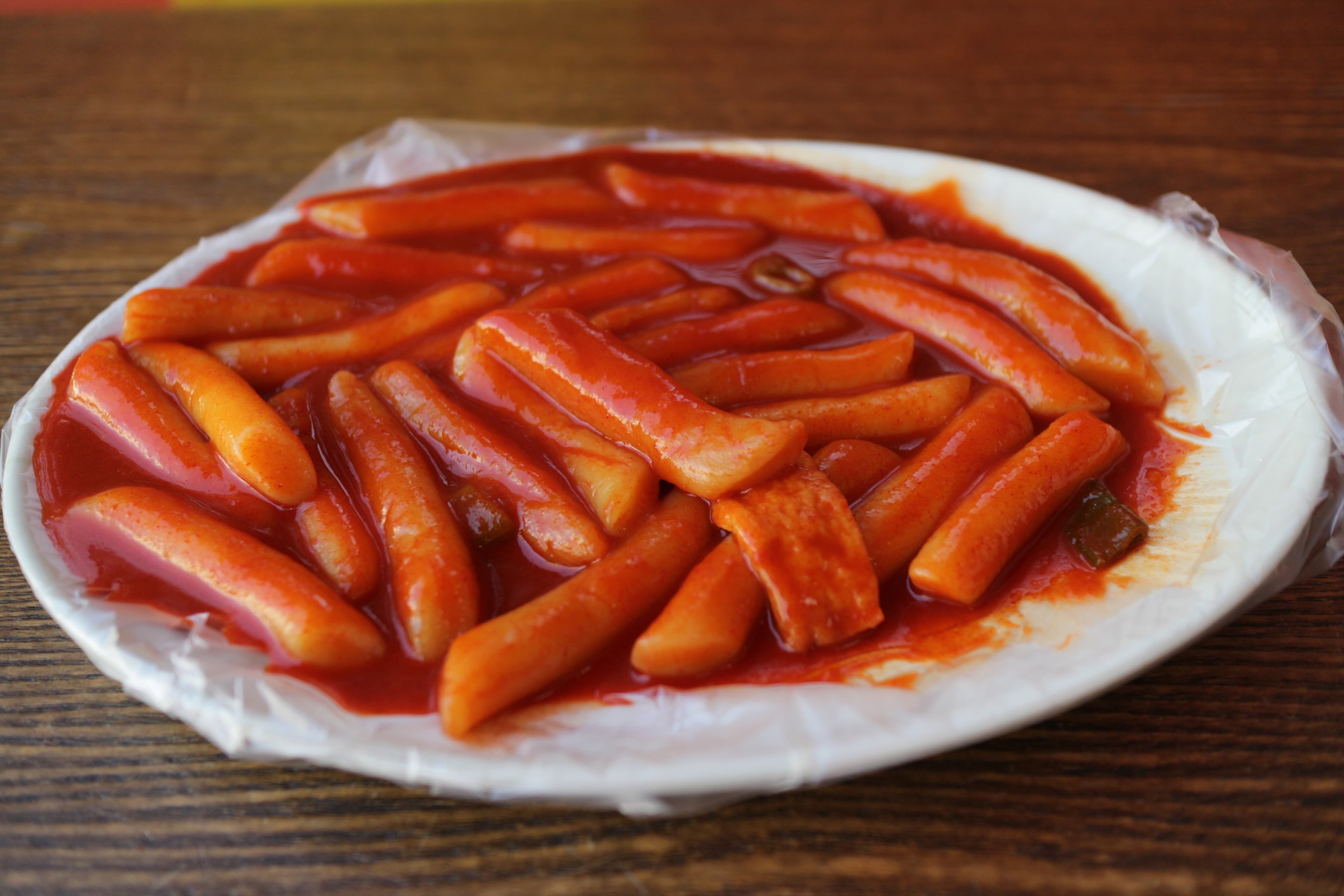
Tteokbokki is typically simmered in anchovy broth and often includes fish cake, even in versions that look like “just rice cakes in sauce.”
Gimbap usually includes a strip of egg and, depending on the type, fish cake or imitation crab — vegetable-only versions exist, but they are a specific request, not the standard.
Doenjang jjigae is usually built on an anchovy or seafood-based broth, even though the soybean paste itself is plant-based.
Sundubu jjigae frequently goes further and includes actual seafood — clams or shrimp — on top of a broth that is often anchovy-based to begin with.
Naengmyeon traditionally uses a beef-based broth, which is easy to miss since the noodles and toppings can look light and vegetable-forward.
Japchae is often made with beef and topped with egg, though the noodles and sauce (soy sauce and sesame oil) are usually plant-based on their own.
Jeon (Korean pancakes) may use egg in the batter or coating, depending on the type, so it is worth asking rather than assuming a vegetable-topped pancake is egg-free.
Instant ramen can be another trap, especially for anyone stocking up at a convenience store. Even if the visible flakes look vegetable-based, the soup powder in many popular Korean ramen products contains beef- or anchovy-based flavoring. That said, this varies a lot by product: some Korean brands make dedicated vegan instant noodles, and some manufacturers now sell a vegan version of an otherwise non-vegan classic. The only reliable approach is to check the full ingredient list — flakes and soup powder both — on the actual packet in front of you, rather than judging by the toppings.
Why Even the Staff May Not Know Every Ingredient
This part matters more than it sounds like it should. Korean restaurant kitchens often rely on premade sauces, seasoning mixes, pre-portioned broth bases, and a rotating set of side dishes (banchan). That means the person taking your order — even the owner — may not always know, with complete certainty, exactly what is in every component of every dish.
This is not about restaurants being careless. It is a structural reality of how a lot of Korean food service works day to day. A staff member telling you “아마 안 들어갈 거예요” (probably not in there) is usually an honest answer, not a dismissive one — it just is not the same thing as a guarantee. If you need certainty, the more specific and narrow your question, the better your odds of getting an accurate one.
What About Temple Food?
Korean temple food (사찰음식) is often mentioned as the safest option for vegans, and there is real substance behind that. According to Korea's official tourism information, temple food excludes animal-based ingredients with the exception of dairy, and it also avoids “oshinchae” — five pungent vegetables: green onions, garlic, chives, wild chives, and Chinese squill — based on Buddhist principles that go back centuries.
That dairy exception is worth pausing on: it means temple food is not automatically the same thing as strict vegan by definition, even though it excludes meat, fish, and eggs. If a strict vegan standard matters to you, it is still worth asking specifically about dairy, rather than assuming temple food is a guaranteed match.
Vegan, Vegetarian, or Lacto-Ovo — Know Which One You Are
These terms get used loosely, but they mean different things, and being clear on your own definition makes ordering in Korean much easier:
- •Vegan excludes all animal products — meat, fish, seafood, eggs, dairy, and typically honey.
- •Vegetarian excludes meat and fish but may or may not include eggs or dairy, depending on the person.
- •Lacto-ovo vegetarian excludes meat and fish specifically, but includes both eggs and dairy.
If you know which one you are before you sit down, you can skip the label entirely and just name your ingredients — which, in a Korean restaurant, tends to work better anyway.
How to Actually Order in Korean
Saying “I'm vegan” is a fine start, but naming the actual ingredients you avoid is usually more useful than the label itself, especially since “비건” is a borrowed English word that not every restaurant uses the same way. Naming ingredients also solves the “no meat” gap from earlier — it forces the broth question into the open. Before ordering, it also helps to know the basics covered in how to order at a Korean restaurant.
If you just want to avoid meat (simplest, least strict)
고기는 빼주세요.
(gogi-neun ppae-juseyo)
“Please leave out the meat.”
Good for a quick, casual request — but this alone will not flag broth, fish sauce, or seafood, so it is not enough for anyone avoiding those too.
If you are vegetarian and also want to avoid fish-based broth
고기, 생선, 해산물은 못 먹어요. 육수에도 들어가면 안 돼요.
(gogi, saengseon, haesanmul-eun mot meogeoyo. Yuksu-e-do deureogamyeon an dwaeyo.)
“I can't eat meat, fish, or seafood. It should not be in the broth either.”
This covers more ground than the meat-only phrase, but it still does not mention eggs or dairy.
If you are strictly vegan
저는 비건이에요. 고기, 생선, 해산물, 계란, 유제품을 먹지 않아요. 혹시 육수나 소스에도 들어가 있을까요?
(Jeo-neun bigeon-ieyo. Gogi, saengseon, haesanmul, gyeran, yujepum-eul meokji anayo. Hoksi yuksu-na soseu-edo deureoga isseulkkayo?)
“I'm vegan. I don't eat meat, fish, seafood, eggs, or dairy. Could you tell me if it's in the broth or sauce too?”
Phrasing the broth question this way — as a genuine question rather than a rule — tends to get a more careful, thought-through answer.
Asking what is in the broth is useful. Asking a restaurant to replace the broth with plain water is a different question. For a lot of Korean soups and stews, the broth is not a garnish you can just remove — it is the base the whole dish is built on, and it is often already made in a big batch or from a pre-made stock. A kitchen may not be able to make a one-off water version on request, and even if they technically can, the dish will usually taste noticeably flatter without it. Rather than assuming that is an option, it works better to ask carefully and accept “no” gracefully if that is the answer.
If you would rather ask about the broth than assume it can be swapped (situational, not universal)
혹시 이 메뉴는 고기나 해산물 육수 없이 조리할 수 있을까요? 어려우면 괜찮아요.
(hoksi i menyu-neun gogi-na haesanmul yuksu eopsi jorihal su isseulkkayo? eoryeoumyeon gwaenchanayo.)
“Would it be possible to make this dish without a meat or seafood broth? If that's difficult, that's okay.”
This is a situational, optional question — not something that works for every dish, and not a request to phrase as a demand. It is there for dishes where it might genuinely be possible, asked in a way that gives the kitchen an easy way to say no.
If the answer comes back uncertain
확실하지 않으시면 편하게 말씀해 주세요.
(Hwaksilhaji anheusimyeon pyeonhage malsseumhae juseyo.)
“If you're not sure, please feel free to just tell me.”
This one is small but useful — it tells the staff that “I don't know” is a completely acceptable answer, which can prevent a rushed “no” that is not actually accurate.
A Quick Note on Allergies
This guide is about food preferences — vegan and vegetarian eating — not medical allergy safety. If you have a food allergy, especially a serious one involving shellfish, fish, or eggs, treat this article as general orientation only, and communicate your allergy directly and specifically to restaurant staff, ideally with a written note in Korean, rather than relying on vegan or vegetarian phrasing alone.
If Your Diet Is Strict, Start With a Vegan Restaurant
If you need a strict vegan standard with no exceptions, the most reliable option is a dedicated vegan restaurant or a menu that is clearly labeled vegan. That is not because general Korean restaurants are unwilling to help — it is because broth, premade seasoning products, sauces, and the rotating side dishes that come with most meals make it genuinely hard to verify every ingredient with full certainty, even with a cooperative staff. For everything else, the questions and phrases above will get you further than the label “vegan” alone.
The Short Version
Nothing on this list means you cannot eat well in Korea as a vegan or vegetarian — plenty of people do it happily every day. It just means the more useful question usually is not “is this vegan?” but “what is actually in this?” Ask about the broth. Name your ingredients instead of just the label. And if the answer feels uncertain, that is a normal part of eating out here — not a sign that no one is trying to help you.