What Does "Buldak" Mean?
Bul (불) means fire and dak (닭) means chicken, so buldak is literally "fire chicken." Before it was a noodle brand, buldak was the name of a very spicy chicken dish in Korea — chicken in a fiery red sauce, the kind of plate people order on purpose when they want to sweat a little. Samyang borrowed that idea for its noodles, and the full product name, 불닭볶음면 (buldak-bokkeum-myeon), roughly means "fire chicken stir-fried noodles."
In everyday Korean, people usually just say 불닭. Said at a convenience store, there is a good chance it means the noodles rather than the chicken dish. It also works as a loose name for Samyang's whole spicy noodle line — the original, the carbonara version, the extra-spicy one — instead of one specific cup. So if a Korean friend says "let's get buldak," it is fair to ask which one.
How Buldak Ramen Started
Samyang's official brand story puts the starting point in 2011, in Myeongdong, one of Seoul's busiest shopping streets. Kim Jung-soo of Samyang noticed young diners at a restaurant working through a plate of fiery buldak chicken, and the idea grew from there: what if ramyeon could carry that kind of heat? After about a year of development, the original Buldak Ramen came out in April 2012.
It started small. According to Samyang, the first exports went to just three markets — Japan, Germany, and New Zealand. By the end of May 2026, the company said the Buldak brand had passed 10 billion units sold worldwide, with cumulative sales of roughly 7 trillion won, and that it is now sold in more than 100 countries. For a product that began with three export markets, that is a long way to travel.
What Makes Buldak Different From Regular Ramyeon?
Most Korean ramyeon is soup. You boil the noodles in water, add the seasoning, and eat the noodles together with the broth. Buldak goes the other way. Samyang describes it as boiling the noodles, draining the water, and then stir-frying them with the sauce, so you end up with sauce-coated noodles and no broth.
The cup versions follow the same idea in a simpler way: add hot water, let the noodles soften, pour most of the water out, then mix in the sauce. Read the lid before you start. If you are used to soup-style cup ramyeon, the draining step is the one that is easy to forget.
As for taste, Samyang's own description is short: spicy and savory. Some people also describe the original as a little sweet under the heat, but that part comes down to personal taste — the spice is what most people notice first. And despite the name, do not expect big pieces of chicken in the cup; the "chicken" side of Buldak lives in the sauce.
How the Fire Noodle Challenge Spread
Outside Korea, a lot of people met Buldak through a video before they ever saw it on a shelf. A 2014 Korean Englishman video, in which the YouTube channel's British friends tried the noodles, is often credited with helping spark what became the Fire Noodle Challenge. Samyang's own timeline puts the big moment a little later and says #FireNoodleChallenge spread widely online in 2015.
The format was simple. Someone eats Buldak on camera, the heat kicks in, and the reaction becomes the content. Those videos turned a Korean instant noodle into a dare people wanted to try for themselves. For many people in Korea, though, it is still just a spicy cup you might grab for a late-night snack, which is part of what makes its second life online a little funny — the same cup on a convenience store shelf is, somewhere else, a challenge with its own hashtag.
Original vs. Carbonara
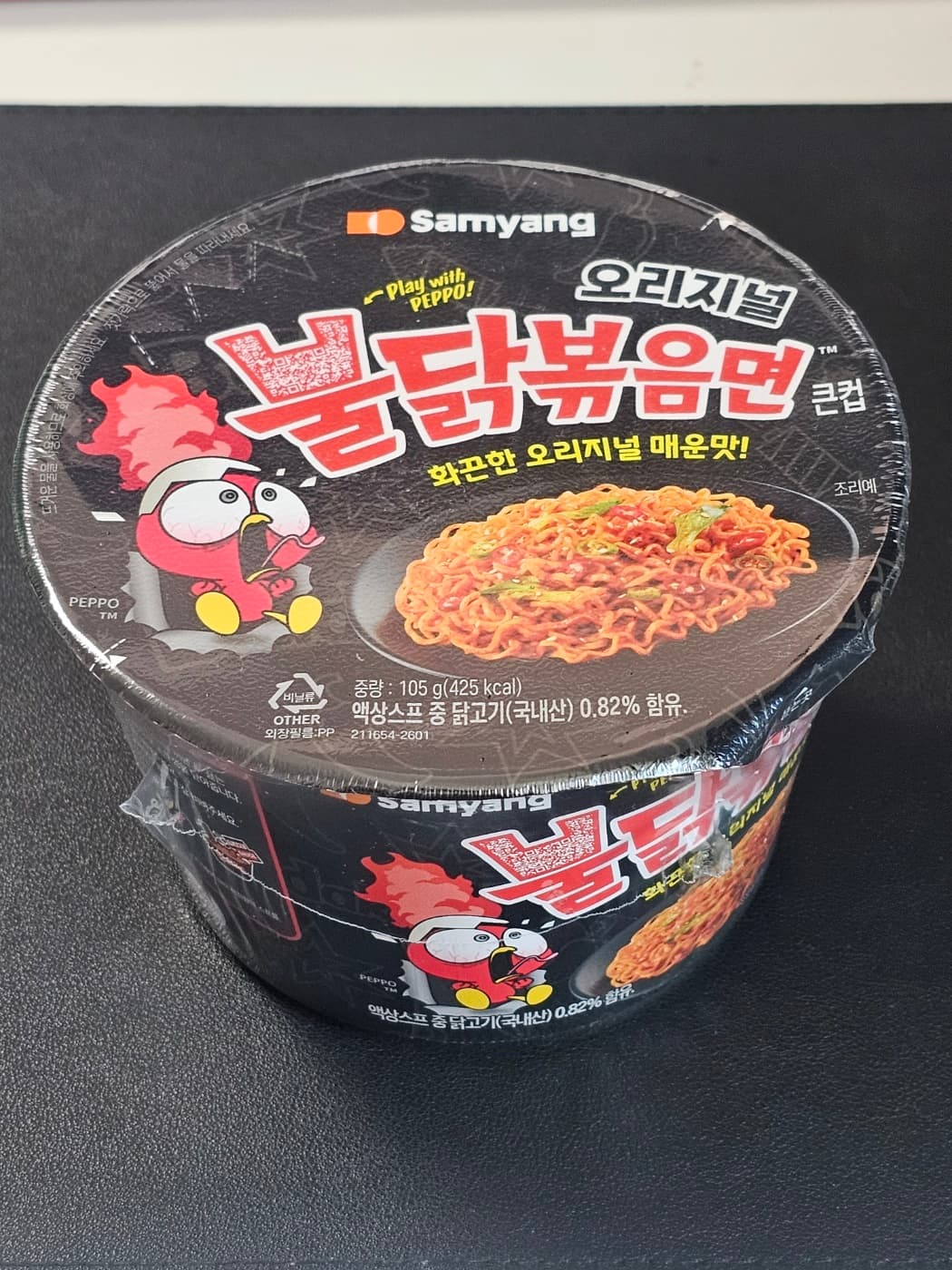
The original is the black package with the red Buldak logo, like the large cup in the photo above. It is the reference point for the whole line and the version people usually mean when they talk about Buldak's heat.
Carbonara joined the Buldak lineup in 2018. It keeps the Buldak idea but adds a creamy, carbonara-style sauce, and Samyang rates it lower than the original on its own spice scale. If you are curious about Buldak but nervous about the heat, carbonara is the version people often suggest starting with. The lineup has grown well beyond these two over the years, with more flavors and formats, so the shelf can look a bit crowded — but original and carbonara are the two names worth knowing first.
How Spicy Is Buldak?
Spicy enough to take seriously. Samyang uses its own five-step Buldak Spicy Level scale to compare its flavors: carbonara sits at Level 2, the original at Level 4, and 2X Spicy at the top, Level 5. That gives you a rough map of the lineup without needing any lab numbers. If you do not eat much spicy food, a few simple habits help:
- •Start with carbonara, or split one cup of the original with a friend.
- •You do not have to use all of the sauce. Add it a little at a time and stop where it still feels good.
- •Keep milk or a yogurt drink nearby. Cold water alone often does not help as much as people hope.
- •Eat it with something plain — a triangle gimbap or a boiled egg from the same convenience store works well.
And if you are trying it for a video, there is no prize for finishing the whole cup in one go. Taking breaks is completely normal. Spice tolerance is personal, and plenty of people in Korea find the original hot too, so there is nothing strange about needing a glass of milk halfway through.
Where Can You Find Buldak in Korea?
You usually do not have to look hard. Buldak is a regular sight in Korean convenience stores and supermarkets, and you will often see it in both cup and packet form. A convenience store is the easiest place to start, because you can buy a cup and eat it right there — many stores have a hot water dispenser and a small counter by the window. Our cup ramyeon guide walks through that routine step by step.
Supermarkets and bigger marts tend to carry more flavors and multi-packs of the packet version, which is handy if you want to cook it at your accommodation or bring a few home. Flavors come and go, so the exact lineup you see can change from store to store.
It also helps to know a few words on the package. 오리지널 (original) marks the classic one, 까르보 (kkareubo) is short for carbonara, and 핵 (haek) — literally "nuclear" — is the word on the extra-spicy 2X version. You do not need to read Korean to pick one, but spotting 까르보 or 핵 on a cup tells you a lot about what you are getting into.
A local note from HAEMIL
The photo on this page shows one product: the original Buldak in a large cup, or 큰컵 (keun-cup). It is just one example. Buldak also comes in regular cups and packets, and the flavors on the shelf change over time. If you are aiming for a milder one, check the flavor name on the package before you pay — the packages can look similar at a glance.